


Fans
Fan
FANS
The radiator fan has an extremely important job in the engine compartment. It must cool the antifreeze that circulates the engine by either pushing or pulling air through the radiator core.
Fan designs are vehicle specific and based on cooling requirements but all have the same basic function, which amounts to drawing in extra air, especially at low speed conditions such as traffic jams and/or when vehicle is idling for a prolonged period of time.
FAN TYPES
Fixed Fan
Earliest automotive cooling fan design and usually a four-blade pattern and is driven directly off a pulley, via a belt from the crankshaft. It spins constantly, as it has no clutch to disengage it as draws air, pulling it through the radiator core irrespective of the engine speed thus creating parasitic load on the engine and reducing the engine actual power output.
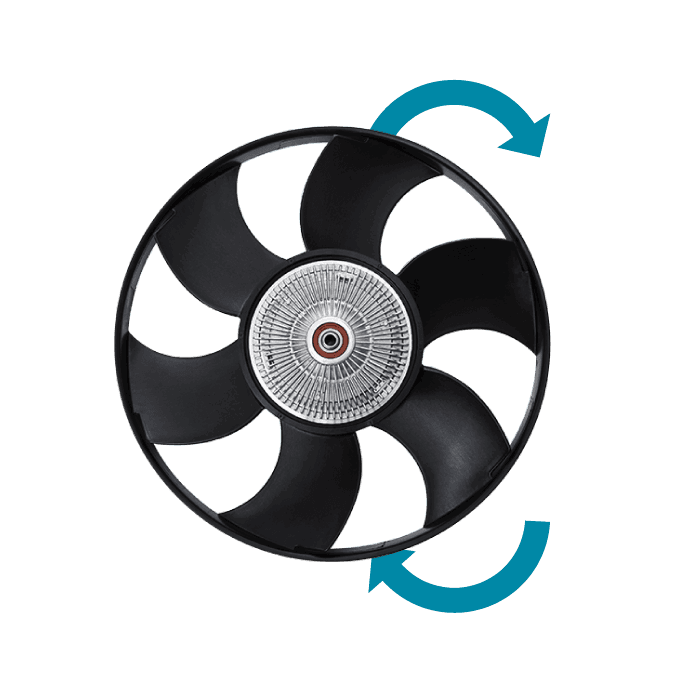
Thermal Sensing Clutch Fan
Most commonly fitted to RWD vehicles due to their longitudinal drivetrain layout. Comprised of a Fan Blade and disk-like housing that forms the hub of the fan and is usually mounted to and driven off the water pump pulley. Most fan clutches are viscous or "fluid" couplings, and uses bi-metallic sensor similar to that in a thermostat to engage it.
When the engine is cold it is partially disengaged allowing the engine to warm up faster, relieving any parasitic load on the engine, thus saving power.
However, if engine temperature rises above the clutch's engagement temperature setting, the fan becomes fully engaged, thus pulling or pushing air through the radiator core to maintain or lower the engine coolant temperature to an acceptable level.
At higher speeds where the air has a "ramming" effect on the radiator, the fan clutch usually will disengage as it needed.
Electric Fans
Electric fans have many advantages especially when it comes to small and compact cars, where size limitations are the main consideration.
Small and powerful, multiple electric fans can be mounted either in front of the grill to push air or behind the radiator to pull in air. Most electric fans are usually controlled by the thermoswitch, or the vehicle’s ECU and only operate when needed thus have no negative parasitic power losses on the engine.
Some designs even run after the engine has been shut off to bring the temperature back to normal specifications.